

Discover the wonders of India
With its rich history, majestic architecture and vibrant traditions, India offers curious travelers an abundance of awe-inspiring experiences. Read on to deepen your knowledge of Indian spices, delve into the history of the Taj Mahal and learn about the incredible wildlife that visitors may be able to see at Kaziranga National Park.

India
India is a large country in South Asia with a total area of 1,269,292 sq mi. (3,287,469 sq km)—roughly six times the size of France. It is bordered by Pakistan to the northwest; by Nepal, Bhutan and China to the north; and Myanmar and Bangladesh to the east. On its northern side, India is set off from the rest of Asia by the majestic Himalayas. Composed of 28 states and eight union territories, India is one of the most ethnically and religiously diverse countries in the world.
Archaeological evidence shows that the highly sophisticated Indus civilization existed in the northwestern portion of the Indian subcontinent from 2600–2000 BC. Since then, India has developed rich intellectual traditions in mathematics, astronomy, architecture, literature and music.
In 1858, the British Empire began direct administration of India, unifying the subcontinent under a single political and economic rule. In 1947, British rule came to an end, and the subcontinent was partitioned into two separate countries—India and Pakistan.
India is characterized by a monsoon climate. From mid-June to the end of September, much of the country experiences hot, wet weather. Between October and February, the weather is cool and dry, and between March and mid-June, it is hot and dry. Temperatures reach their peak in May and June, prior to the cooling monsoon rains.
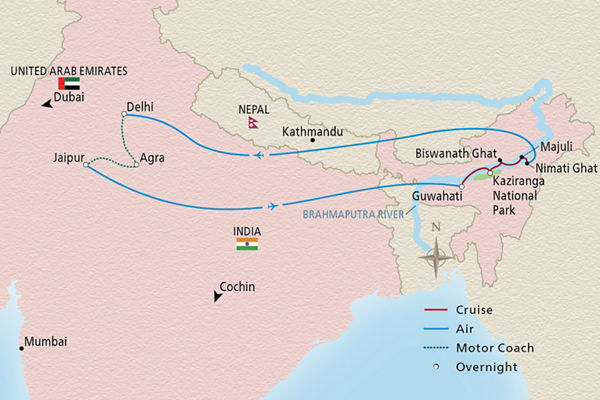
A large portion of India’s territory drains into the Bay of Bengal via the Ganges and Brahmaputra rivers. The Ganges, which is considered sacred by the country’s Hindu population, is 1,560 mi. (2,510 km) long. The Brahmaputra River originates in the Himalayas at the lofty altitude of 17,366 ft. (5,293 m). It is longer than the Ganges—about 1,800 mi. (2,900 km)—but only 450 mi. (725 km) of its meandering course lies within India. Locals use the Brahmaputra River for irrigation and transport, and a wide variety of animal species—including the greater one-horned rhinoceros—call its shores home.

-
Indian spices
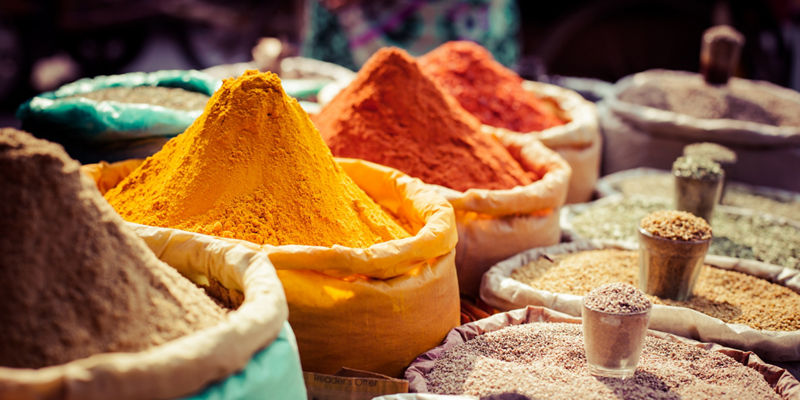
Given India's incredible diversity and richly layered history, it is likely no surprise that the country’s culinary traditions are equally varied. Yet, most of India’s regional cuisines share a crucial common denominator—their masterful use of herbs and spices. Here are ten popular spices that you may encounter when sampling local fare:
- Aniseed
Derived from the Pimpinella anisum plant, these small, aromatic seeds have a licorice-like flavor. In India, they are often eaten after a meal to freshen the breath and help with digestion. They may be offered on their own or in mukhwas, an invigorating mix of seeds and nuts. - Cardamom
Green cardamom pods have a sweetly spicy flavor, while black cardamom is smoky. The pods may be cooked whole or cracked open to reveal the seeds, which are then ground. Ground cardamom is a key component of garam masala, a spice blend that is a staple of many Indian dishes. - Kashmiri red chili powder
Indian cuisine relies on many kinds of chili powders, including cayenne, but Kashmiri red chili powder is among the most popular. It has a mild flavor and vibrant red hue. Famously, this powder gives tandoori chicken—roasted in a traditional clay oven—its signature reddish-orange color. - Cinnamon
Typically, Indian cuisine incorporates Ceylon cinnamon, grown in Sri Lanka, rather than Cassia cinnamon, which is more predominant in Southeast Asia. Although both varieties are warm and bright, Ceylon cinnamon has a sweeter, less pronounced flavor. - Clove
Cloves are the dried flower buds of the Syzygium aromaticum plant, a tropical evergreen tree thought to be indigenous to Indonesia. With their robust flavor and heady aroma, cloves add warmth and depth to many Indian dishes. They may be used whole or as a ground powder. - Coriander
Coriander consists of the small, dried seeds of the cilantro plant. This spice—one of the most common in Indian cuisine—has a bright, earthy flavor. - Cumin
Cumin seeds, which come from a plant in the parsley family, may be used whole, roasted or ground. Cumin is an essential ingredient in many spice mixes, chutneys and curry powders. You may also encounter it in raita, a yogurt-based side dish that is often paired with spicy food. - Asafoetida
Asafoetida, also known as hing, is a gum resin extracted from an herb in the celery family. In concentrated quantities, it has a pungent, sulfuric smell, but when used sparingly, the flavor is smooth, mild and reminiscent of onions or leeks. When preparing dishes with asafoetida, it is best to cook the resin with fat, like oil or ghee (clarified butter), and other spices before adding protein, vegetables or carbohydrates. - Indian bay leaf
Indian bay leaf, which comes from the Cinnamomum tamala plant, is distinct from the bay leaves more common in the United States and Europe, derived from bay laurel trees. With their cinnamon-like flavor, Indian bay leaves are often used in curries, spice blends and biryani (a popular dish consisting of spiced rice, meat and vegetables). - Turmeric
Turmeric is a rhizome, or a subterranean plant stem. It has a bright yellow-orange color and a warm, earthy flavor. The stem may be peeled and used fresh, or it may be dried and crushed into a brilliant golden powder.
- Aniseed
-
Kaziranga National Park
Kaziranga National Park encompasses 165 sq mi (430 sq km) of marshland, forests and open jungle. Located in the north-central Indian state of Assam, on the south bank of the Brahmaputra River, this scenic area was first established as a reserve in 1908. In 1974, the sanctuary became a national park, and it was later designated a UNESCO World Heritage Site in 1985.
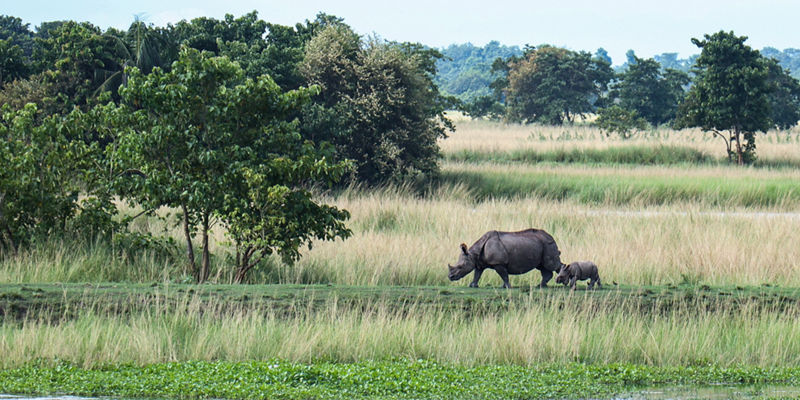
Kaziranga is home to the world’s largest population of greater one-horned rhinoceri (Rhinoceros unicornis), also known as Indian rhinoceri. These incredible creatures are identifiable by a single black horn that can measure 8–25 in (20–64 cm) long. They weigh between 4,000 and 6,000 lbs (1,800 and 2,700 kg) and are similar in size to the white rhinoceros of Africa. They are larger than the African black rhinoceros and Indonesia’s Javan rhinoceros.
The park is also home to a wide variety of other wildlife, including Indian elephants, water buffalo, gibbons, leopards, panthers, sloth bears, wild pigs, swamp deer, pelicans and storks. In 2006, Kaziranga was also designated a tiger reserve, due to its large population of Bengal tigers.
Jeep excursions into Kaziranga National Park offer visitors the opportunity to see these incredible creatures and to learn about the park’s ongoing conservation efforts.
-
Taj Mahal
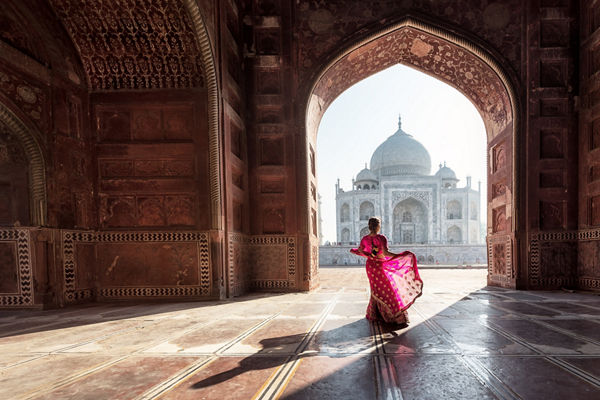
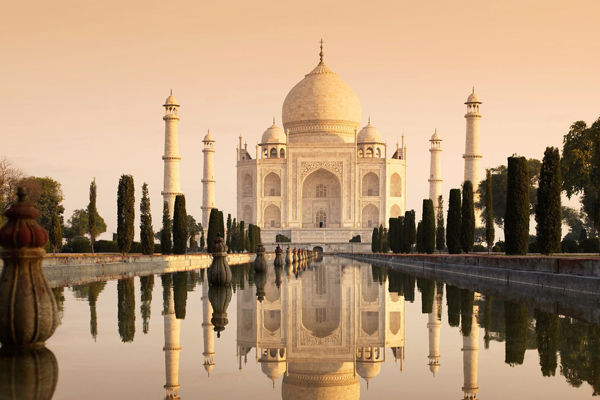
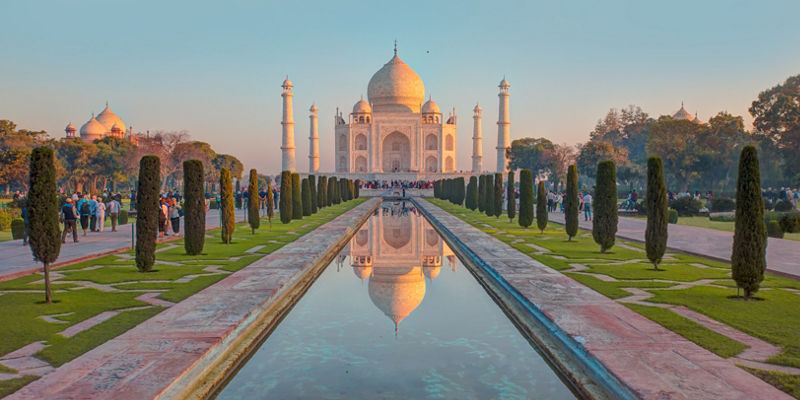
The Taj Mahal is arguably one of the most iconic architectural wonders in the world. This white marble mausoleum complex in Agra was built by the 17th-century Mughal emperor Shah Jahān to commemorate his empress consort, Mumtaz Mahal, who died giving birth to the couple’s 14th child.
Born Arjumand Banu, Mumtaz Mahal became betrothed to Shah Jahān in 1607, but based on the advice of court astrologers, the couple did not marry until 1612. In 1628, Shah Jahān acceded the throne and gave his wife the title “Mumtaz Mahal,” meaning “Chosen One of the Palace.” In 1631, she accompanied her husband on a military campaign and went into labor while in Burhanpur, a city in central India. She was temporarily buried there until January 1632, when her body was transferred to Agra, the Empire's capital city in northern India. That same month, construction of the Taj Mahal began on the site of her grave.
The Taj Mahal is a premier example of Mughal architecture—an elaborate combination of Indian, Persian and Islamic styles. The mausoleum features a central dome reaching 240 ft (73 m), towering minarets and a gleaming white marble façade that appears to change color in different light. Throughout the interior, semiprecious stones—including lapis lazuli, jade and amethyst—have been set into the marble, adding color to the vast expanses of white stone. Arabic calligraphy featuring verses from the Qur’an are also inscribed over the soaring arches of the mausoleum entrance and throughout the building.
The complex took 22 years to complete, and more than 20,000 workers participated in its construction. In 1983, the Taj Mahal was designated a UNESCO World Heritage Site.
India Highlights
A journey through India promises exceptional scenic beauty, rich cultural traditions and lively cities that seamlessly blend the old and new. Here are some highlights you may experience during a visit to this historic region:
- See the towering Qutb Minar minaret, a 12th-century marvel
- Explore the heart of Old Delhi by rickshaw
- Watch the sun rise or set over the spectacular Taj Mahal
- Visit UNESCO-listed Fatehpur Sikri, a former Mughal capital
- Discover the ornate architecture of Jaipur, the “Pink City”
- Learn about Assam’s renowned tea industry
- Attend a traditional gayan-bayan dance performance
- Discover life in Biswanath Ghat, a Hindu pilgrimage site
- Search for elephants and rhinos in Kaziranga National Park
- Sample local culinary specialties at a market in Guwahati
India Travel FAQ
Enriching Itineraries—India
Choose one of our immersive voyages and discover the many benefits of exploring in Viking comfort.