

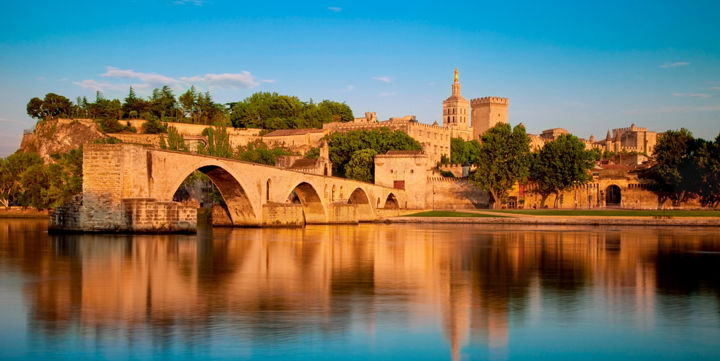
When the Catholic Church acquired Avignon during the 1300s, it quickly transformed the quiet riverside village into a major religious and cultural center. Evidence of the makeover is everywhere. In addition to the enormous palace, the church constructed a wall around Avignon and provided mansion-like residences to its cardinals. Avignon Cathedral was dwarfed by its neighbor, the Palace of the Popes. Centuries after the papacy returned to Rome, the Vatican called for a gilded statue of Mary to be placed atop the cathedral; her golden gaze still welcomes visitors today.
Shore Excursions
Enjoy a complimentary shore excursion in each port of call. Or, choose from a wide selection of optional onshore experiences designed to immerse you in your destination. To learn more, browse some of our most popular shore excursions or explore our cruise itineraries below.


Avignon Walk & Pope’s Palace
Visit the monumental palace, once the seat of seven popes, and explore its medieval city.
Avignon, a UNESCO World Heritage Site, is known as the “City of Popes” because the papacy was relocated here from Rome, amid great controversy, from 1309 to 1377. With a local guide, follow the historic center of narrow streets to the Place de l’Horloge, the city’s central square, a scene of balconies, elegant facades and shading trees. Continue to the renowned Palace of the Popes for a guided tour. This fortress-church—the Middle Ages’ largest Gothic building—is gigantic, dwarfing even the neighboring cathedral. After, continue to the Market Hall, an iconic indoor market with a vertical garden, cafés and stalls selling local produce, meats and cheeses. Enjoy free time to browse the offerings, before returning to your ship.
Lavender Fields of Provence
Learn about the lavender that graces the fields of Provence each summer and visit a family-owned distillery.
Take a panoramic drive by motor coach into the beautiful countryside of Provence, stopping in the village of Coustellet to visit the Lavender Museum. Founded by a family that runs a nearby lavender farm, its collection of objects and exhibits chronicle the flower’s cultivation, history and use by perfume makers and civilizations dating back to ancient Rome. Continue to a scenic viewpoint that overlooks Gordes, a hillside village of stone buildings that is regarded as one of the most beautiful of its kind in France. Have a traditional Provençal lunch before heading to a family-owned lavender distillery. Here, discover how the same family has cultivated this land for generations and gain insight into the distillation process that turns lavender into essential oils.
Please note: this seasonal tour is typically offered from mid-June to mid-July.
Châteauneuf-du-Pape Wine Tasting
Discover the region of Châteauneuf-du-Pape and indulge in a sampling of its superb wines.
Named for its “Pope’s New Castle,” constructed in 1316 by Pope John XXII as a summer residence for the Avignon Popes, Châteauneuf-du-Pape—and the town that grew up around it—is one of the world’s most celebrated wine-producing regions. Set out for a journey into southern France’s most prestigious appellation to visit two long-established wine estates, where you will meet the vintners whose families have lovingly cultivated these vineyards for generations. Explore part of the historic heritage of Provence as you browse their winery cellars and learn about the different types of soil and the delicate blending process behind their extraordinary wine. Toast your experience by sampling the distinctive bouquet and finish of these very special wines in the place of their birth.
Pont du Gard Aqueduct
See the magnificent three-tiered structure built without mortar by Romans 2,000 years ago.
One of the most ambitious engineering projects of its time, the Pont du Gard aqueduct carried water to the Roman outpost of Nimes from the springs of Uzes, 31 miles away. It stands today as the greatest legacy of Marcus Vipsanius Agrippa, son-in-law of Augustus. Some of its stones weigh six tons and were lifted as high as 160 feet. You will journey to the aqueduct, which straddles the wooded banks of the Gardon River. Spend time at the site’s museum, where you can observe the marriage of modern and ancient at fascinating, interactive exhibits. Then marvel at the huge structure that channeled 44 million gallons of water each day over a tiny gradient of 25 inches per mile for 31 miles. For form and function, it is surely one of the Roman Empire’s most breathtaking remains.


